
Long before The Ferment had a name,* I chose to be a witness.
The Ferment asks questions about free speech: who gets to raise their voice, who records it, and what happens to that record afterward. At our Fringe performances, the audience will take part in a staged protest i.e. fictional, and we will record them doing it as a “sound effect” in our podcast. I want to give you more context around this idea.
I started reading my way toward the counterculture during the conformity of the Reagan years looking for others who were, like me, “different” in some way. For a long time I recorded life (and daydreams) only in words – journal, poems and scripts. Then in 2001, I went to work at electric city, Northeast Pennsylvania’s arts and entertainment weekly, which ceased to exist some time after I “left” 10 years ago this month. Our publisher valued the paper mostly for its ad revenue but I took the work completely seriously. Point is – you can’t cover arts and entertainment without acknowledging politics. Everything people make is political. The word comes from the Greek polis, the city and the people who live in it. We are always re-organizing and the arts are communication tools used to move people.
As a journalist, my job was to witness. My opinions ran every other week in a column we called Voices. When I traveled with others from Scranton to New York in 2004 and to Washington in 2005, I brought a camera along with my reporter’s notebook. This fall’s production of The Ferment feels like a good excuse to share some of those pictures.
Saturday, March 20, 2004 — New York City
One year after the U.S.-led invasion of Iraq, people in cities around the world marched on the same day. In Manhattan, tens of thousands filled Madison Avenue for a march and rally near Madison Square Park. United for Peace and Justice organized it, and A.N.S.W.E.R. and dozens of other groups marched too. The signs asked where the weapons of mass destruction were and who would answer for the intelligence that sold the war. Everywhere you looked: BRING THE TROOPS HOME NOW. We took the bus with a bunch of other Scrantonians. Notably, it felt so safe that my daughters came along.
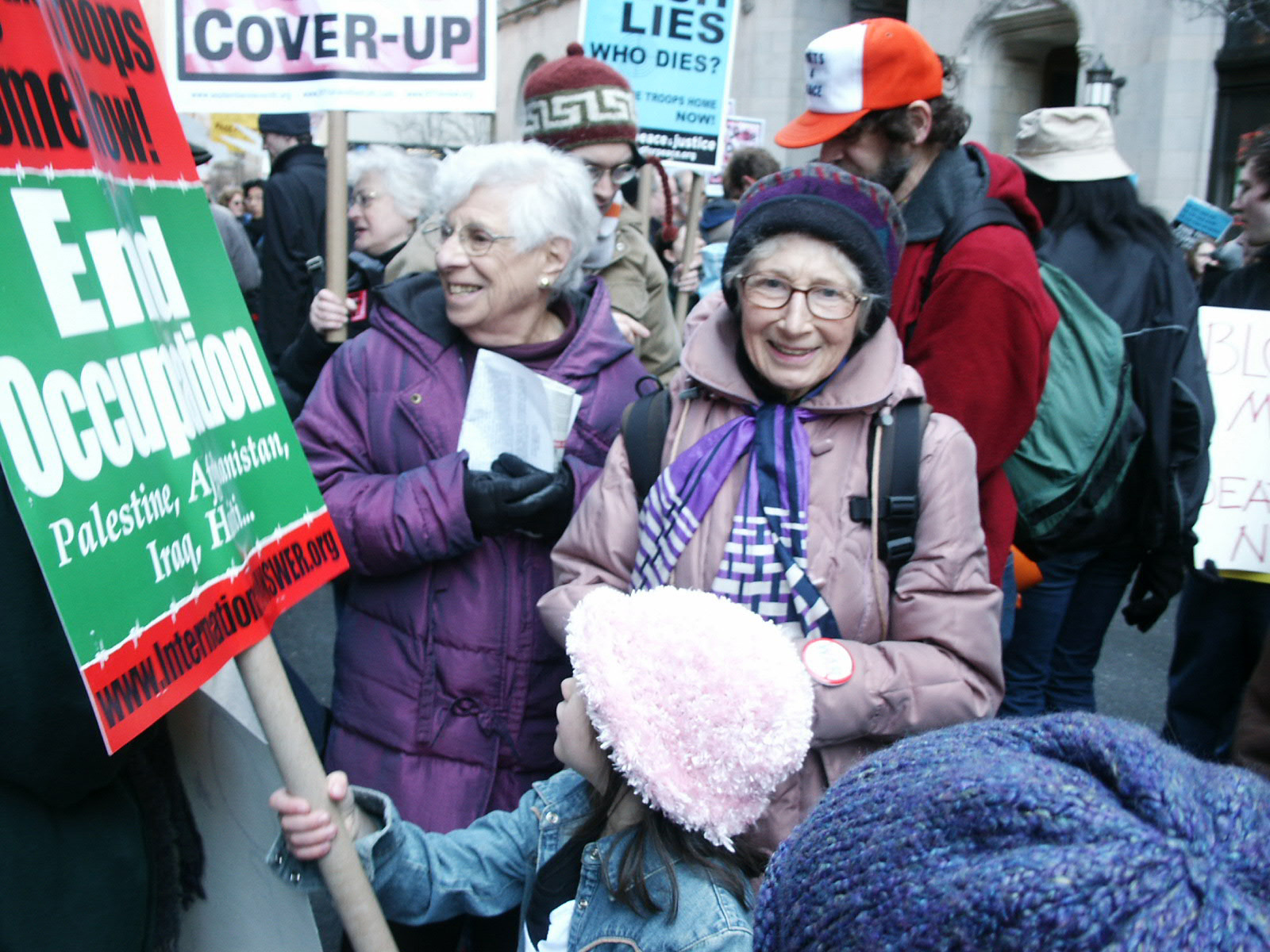
ABOVE: Madison Avenue, NYC. March 20, 2004. My youngest daughter, in the pink hat, holds up an END OCCUPATION sign while the women beside her smile down at her. Her sister’s blue cap peeks in from the corner. Three generations on one sidewalk.
BELOW: NYC. March 20, 2004. Two girls chant behind a hand-lettered STOP KILLING KIDS sign. Around them: MONEY FOR JOBS NOT FOR WAR and BRING THE TROOPS HOME NOW.

I don’t remember much about that day beyond the exhilaration and affirmation of being among a crowd of courageous, concerned citizens exercising their rights to demand better, more compassionate choices from our elected officials. If that sounds threatening, you might be a fascist.
Thursday, January 20, 2005 — Washington, D.C.
Ten months later, I joined a bus trip of locals on a trip to Washington for the second inauguration of George W. Bush. Thousands gathered in the snow at Malcolm X Park (officially Meridian Hill Park) and then marched toward the parade route, where they joined other groups already lining Pennsylvania Avenue. Some people simply turned their backs as the motorcade passed. The concerns were the occupations of Iraq and Afghanistan, and civil liberties here at home under the Patriot Act.
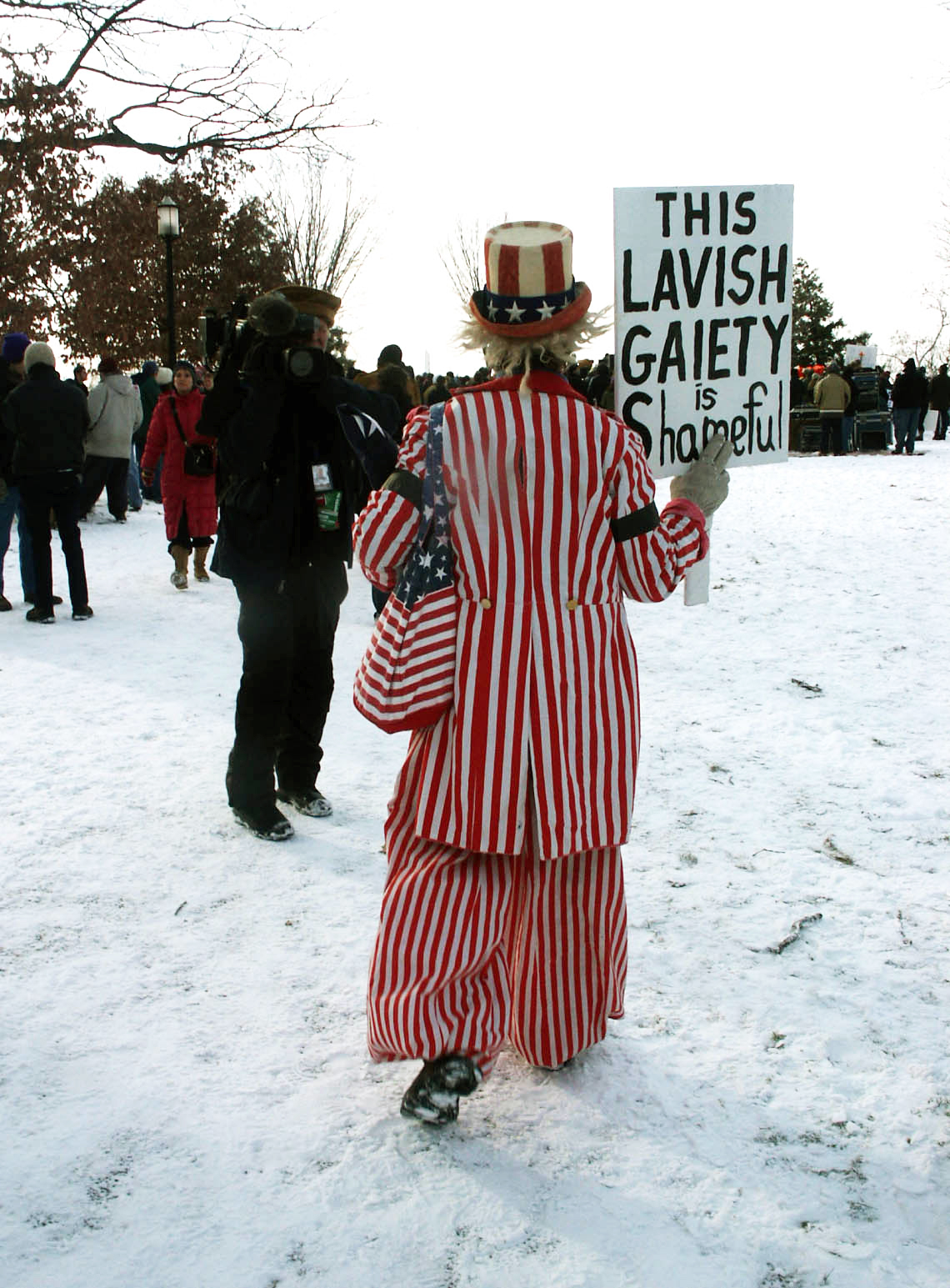
ABOVE: Malcolm X Park, January 20, 2005. A protester dressed as Uncle Sam, black armband on the sleeve, carries a sign that reads THIS LAVISH GAIETY IS SHAMEFUL. A news camera works the crowd a few steps ahead. Everyone was documenting everyone.
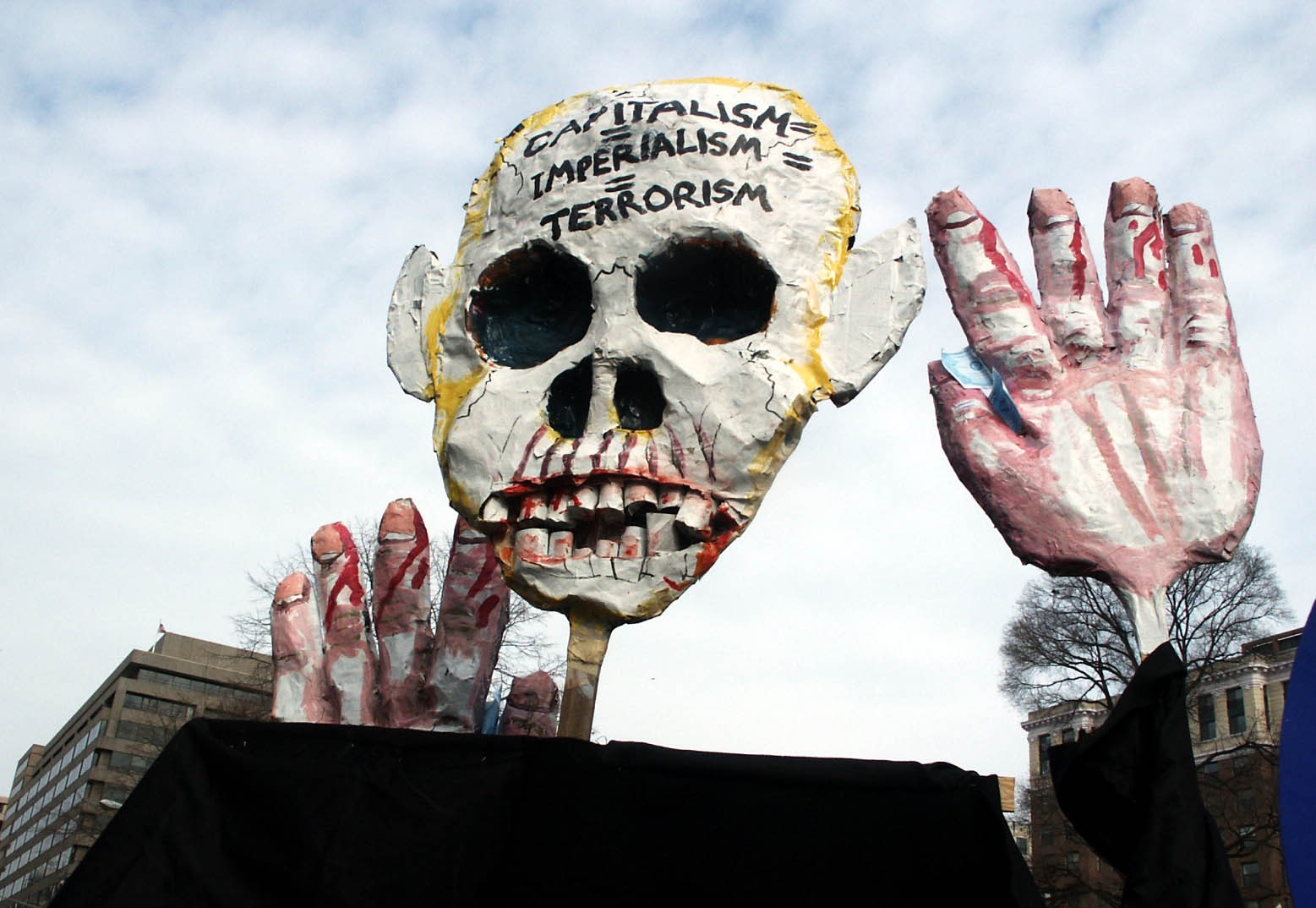
ABOVE: A papier-mâché skull on a stick, CAPITALISM = IMPERIALISM = TERRORISM written across its brow, raised between two giant hands streaked red. Giant puppets belong to a long street-theatre tradition, the one Bread and Puppet Theater carried for decades, and part of the tradition of protest performance from which The Ferment gets its name.*

ABOVE: Street theatre on the park’s stone terrace. Performers in TORTURE U sweatshirts wear the faces of cabinet officials and hold ABU GHRAIB FRATERNITY signs around a figure in a black hood, standing on a crate like the prisoner in the photograph the world had seen the spring before. The charge was complicity: that the people at the top knew about the torture and covered it up.
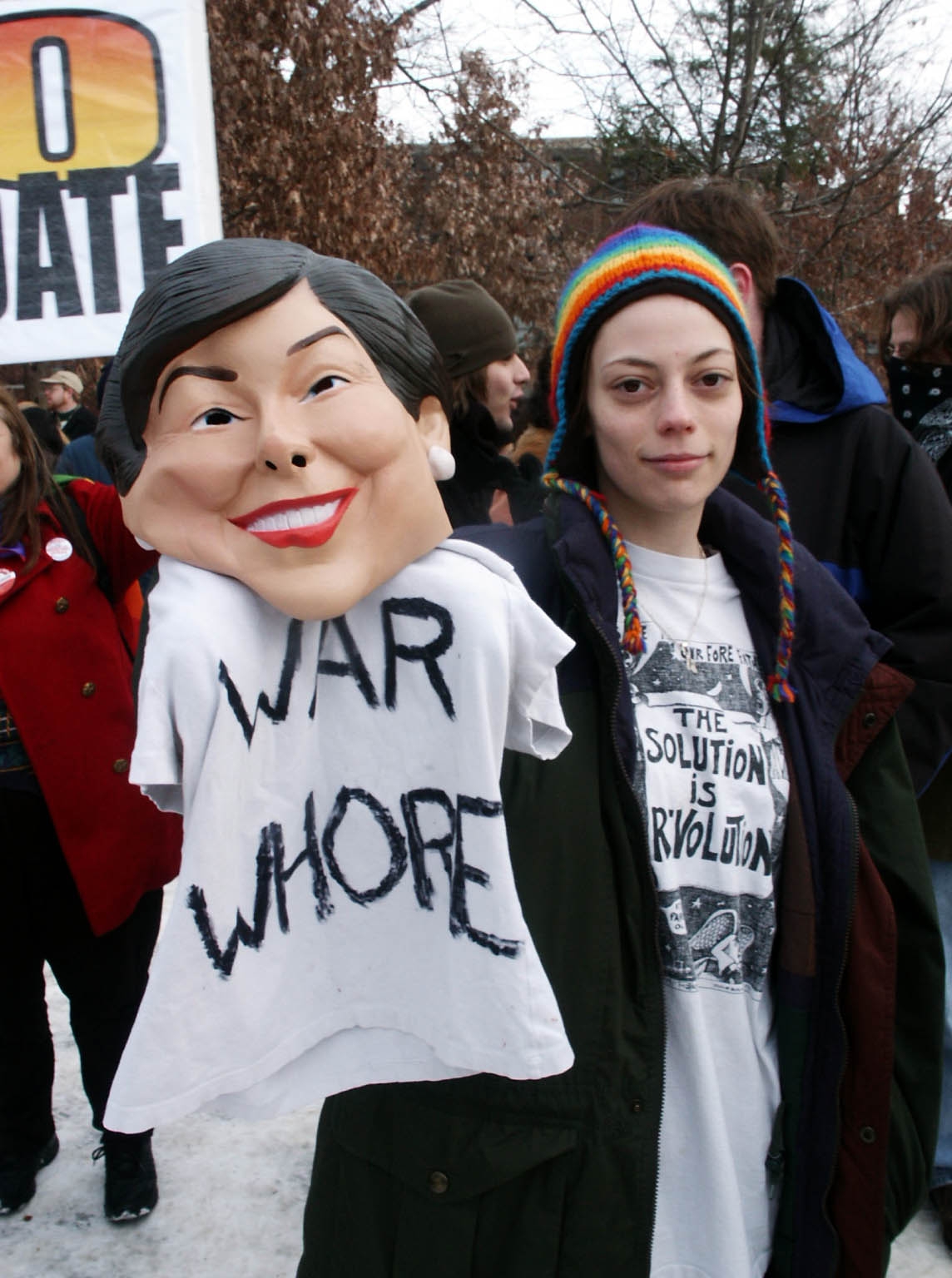
ABOVE: A woman holds up a Condoleezza Rice puppet wearing a shirt painted WAR WHORE. Her own shirt reads THE SOLUTION IS REVOLUTION. Yes, it’s crude. Here we are reporting not condoning, but the insult has nothing to do with sex. It accuses someone in a position of power of selling their word to sell a war, and it would fit a man just as well. -ag
I wrote about that day in a Voices column called “Fringe Benefits.” I went with the Scranton group to the parade route, waited an hour at the security checkpoint, got frisked, and then decided I couldn’t spend two hours staring at the backs of heads. I watched the rest from a brew house at 13th and Pennsylvania, where the parade was playing on CNN. I didn’t see a single protester on that screen. Earlier, on the Metro platform, men in bow ties and women in fur coats had waited on one side of the tracks. On the other side, protesters shivered in mismatched coats, hats and scarves. As I wrote then, “It’s only on the outskirts of the action that a curious mind can really see the full context.”
I could tell you The Ferment isn’t a political play. But it is, because any story about people living inside an agreement they built together will have politics happening in it. These pictures are 20 years old. The questions in them haven’t changed. One I keep writing toward: what do we want for people, no matter who is in charge?
The Ferment plays October 8–10 at the Electric City Trolley Museum as part of the Scranton Fringe Festival. Come raise your voice with us.
Tickets are $15 and can be purchased in advance online at scrantonfringe.org. You can learn more about the show elsewhere on the website (you are here: dramastruction.com)
– alicia lynn grega, writer & creator of The Ferment
*(Re: the choice of the title, you are right to trace it back to Peter Schumann by way of John Bromberg. Rise! It’s an homage and it just makes sense. More on that later).